AI integration and deployment
AI features such as summarisation, classification, search and draft generation for your panel, website or internal application, with secure deployment and cost tracking.
Averis Soft adds AI features to a business's existing software and websites and runs them safely: OpenAI-compatible model APIs or, where suitable, local models; custom AI applications; evaluation sets; usage and cost monitoring; deployment and maintenance with Docker. Its own products, Transify AI and the real estate assistant, were built with the same approach.
What we solve
You have software and your team uses it, but there is no AI inside it. Summarising long records, classifying incoming text, understanding free-text search or producing drafts is still done by hand. Rather than buying a new product from scratch, adding a measurable AI feature to your existing software, in the right place, is often faster and cheaper.
First we identify where the feature genuinely helps and how success will be measured. The model is chosen to fit the need: API-based models, or a local model if the hardware, latency and data requirements suit it. We add the feature to your existing application through an API, test it against an evaluation set of sample inputs and outputs, and launch it while monitoring usage and cost. Where needed, we build a thin abstraction layer so the provider can be switched later.
AI integration and deployment: scope
- Model API integration (OpenAI-compatible endpoints, MiniMax, Anthropic etc.)01
- Local model deployment where hardware, latency and cost allow02
- AI features for your existing panel, website and internal tools03
- Custom AI-powered web applications04
- Evaluation set: the feature is measured before and after launch05
- Usage, cost and error monitoring; budget alerts06
- Deployment, backups, updates and maintenance with Docker07
Who it's for
Describe the task, report or process you want to automate; we'll assess your systems and data and reply within 24 hours.
Request an assessment Message us on WhatsAppHow is pricing set?Step by step
- 1Use case and success metric
Where the feature sits, who it serves and what it saves; how success is measured (time, accuracy, satisfaction).
- 2Model and data flow
API or local; which data goes to the model and which is masked; cost estimate and fallback behaviour.
- 3Integration and evaluation
The feature is added to your application; it is measured against a set of sample inputs and outputs, and prompts and rules are refined.
- 4Launch and monitoring
Usage and cost dashboard, error log, budget alerts; a monthly improvement round.
What it connects to
- Your existing web application and admin panel (REST API)
- OpenAI-compatible model APIs, Anthropic, MiniMax
- Local model servers (on suitable hardware)
- PostgreSQL and your existing database
- Docker-based deployment (your own server or one we manage)
- Monitoring and logging tools
Example flow: a 'summarise and classify' feature in a support panel
- 1A long customer thread is opened in the panel
- 2Personal data is masked and the text is sent to the model API
- 3The model suggests a 3-sentence summary and a topic label
- 4The suggestion appears in the panel; the representative approves or corrects it
- 5Corrections are added to the evaluation set and quality is tracked
- 6A monthly usage and cost report goes to the manager
Example flow. The suggestion is saved only with human approval; personal data is masked before it reaches the model.
What you'll have at the end
- 1Use case and success metric document
- 2Integrated AI feature or application
- 3Evaluation set and measurement report
- 4Usage, cost and error monitoring
- 5Deployment documentation and maintenance plan
Tools we use
- Python / FastAPI
- Node.js
- OpenAI-compatible model APIs
- Local models (where suitable)
- PostgreSQL
- Docker
We choose technology based on your needs; the source code and documentation are yours at delivery.
What we don't promise
- Local models are not always cheaper or better; the decision is made by comparing hardware, latency and maintenance costs.
- Model output is not deterministic; that is why an evaluation set and human approval are mandatory at critical points.
- Personal data and confidential information is not sent to a model without an approved data flow; it is masked or kept out of scope.
- Model providers' price and version changes are tracked; the abstraction layer makes switching easier, but not free.
How we work
- 01We discover the problemWhich work takes time, produces errors or is noticed too late; how success will be measured.
- 02We assess the data and integrationsWhich data lives in which system, what the API and permission status is, whether data quality is sufficient.
- 03We build a focused solutionOne process, a clear scope; AI only at the step where it helps, figures calculated by code.
- 04We test and verifyEnd-to-end trial with real sample records; evaluation set and edge cases.
- 05We launch and monitorLogging, error alerts, usage and cost tracking; rollback if something goes wrong.
- 06We improve over timeNew exceptions are added to the flow and the scope grows with your needs; monthly maintenance round.
Frequently asked questions
Can't find your question here? Write to us and we'll answer within 24 hours.
Ask a questionWhich model do you use?
We choose per task, comparing cost, latency, Turkish-language quality and data requirements. For our own products we chose by measuring different providers; we apply the same method to your project and give you the result in writing.
Is a local model safer?
Data does not leave your premises, but there are hardware, maintenance and quality costs. It can make sense for sensitive data and high volumes; at low volumes an API-based model is usually more economical. We compare the two together during discovery.
How do you keep costs under control?
Set-up from 9,900 TRY, optional monthly monitoring and maintenance from 1,490 TRY/month (excl. VAT). The final price is written in the scope document and never increases without your approval; the discovery call is free. Every call is logged, usage and cost are visible on a dashboard, and an alert goes out if the budget threshold is exceeded. Unnecessary calls are reduced with caching and rules.
Do you need to change our existing software's code?
Usually a small addition is enough: the feature runs as a separate service and your application calls it through an API. If there is no access to your source code, integration at the interface level is also possible.
How do you prove the feature works?
Against the metric set before launch: for example, summary quality is scored on the evaluation set and processing time is measured. The report is in writing; instead of inflated general claims, the result on your own data speaks.
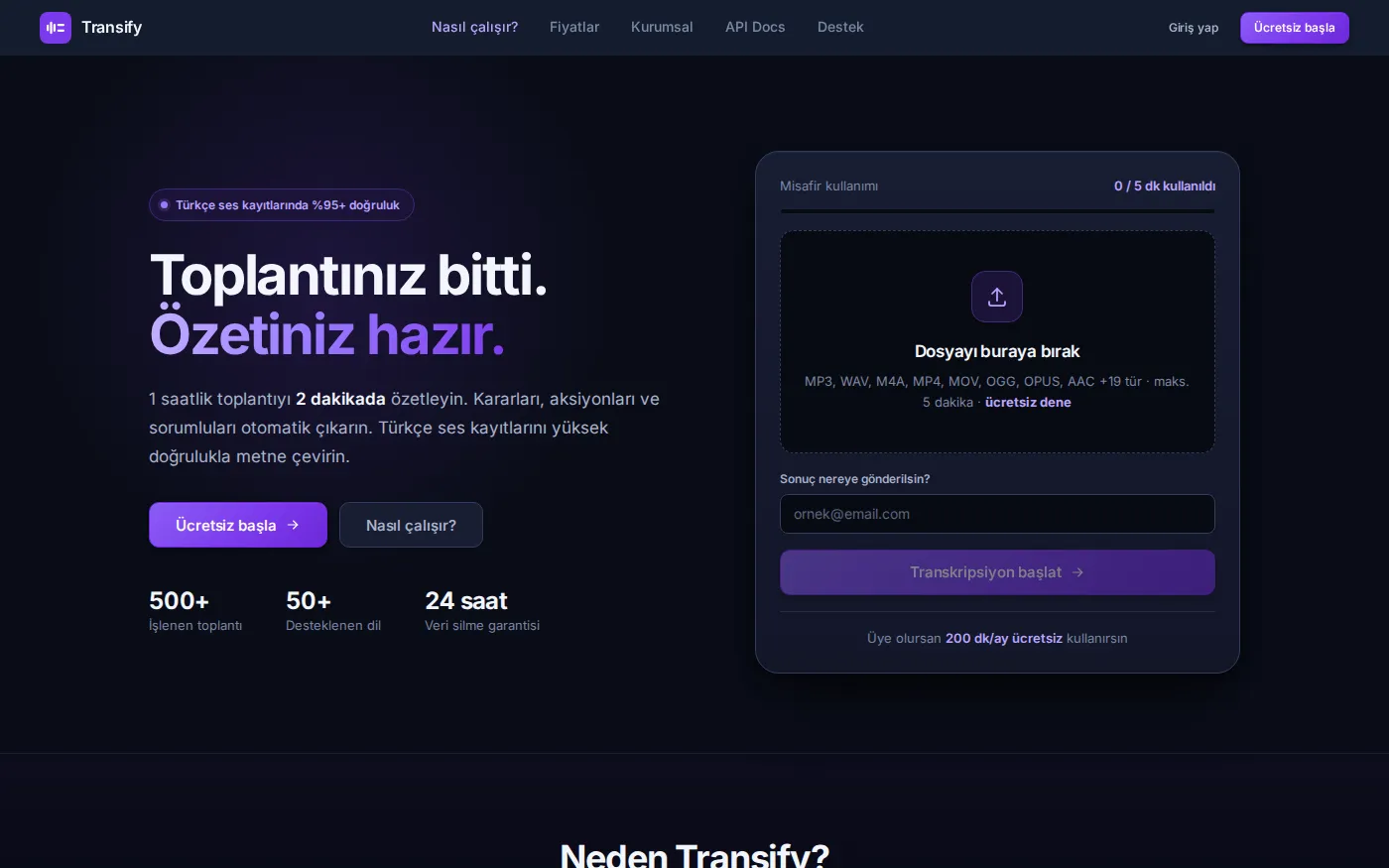
Were Transify and the real estate assistant built this way?
Yes. Both are our own products, using external model APIs, evaluation and Docker deployment; we use the same building blocks in client projects.
How long does it take?
We start with a single-process pilot; the timeline is written in the scope document. The discovery call is free and we answer quote requests within 24 hours.
Services and solutions that go together
Guides on this topic
What is an AI agent? When it helps a business, and when it is risky
What is an AI agent and how does it differ from a workflow? Where agents help businesses, the risks, and the permission, approval and logging rules for a safe set-up.AI integration for ERP and CRM: how it's done and what to watch
How is AI integrated into ERP and CRM? Three set-up routes, use cases by module, data and privacy, permission and approval rules, a step-by-step plan.Which task, report or process would you like to automate?
Describe it briefly; we reply within 24 hours. The discovery call is free.